
 Menu
MenuNew High Intensity Training Technique
Click Here For Free Strength Training Magazine Subscription
A New Intensity: The DART Method
By Mike Berry, President/Owner of Power-Up USA, Inc.
"Repetitions should be performed as fast as possible with maximal mental concentration for recruitment of the maximum firing levels of muscle fibers as required in maximal human performance." — Gideon B. Ariel, PhD
Intensity can be and has been defined in many different ways by many different people as it applies to the discipline of strength training. It is my opinion that the intensity of the effort on each repetition as quantified by the resulting power output creates a training intensity and stimulus that results in superior physical improvements. The findings of research studies cited below and the scenarios provided below them, lend support to that opinion and suggest that there exists a logical progression and hierarchy of more useful and effective strength training methods: Super Slow — Traditional Weight Training — Compensatory Acceleration Training — Dynamic Accentuated Resistance Training. *Note: DART is term and acronym that I created specifically for the purposes of this article. DART is a term that can be used to describe free-weight variable resistance training more accurately.Read the following evidence and judge for yourself.
Study One — A recent research study using experienced weightlifters as subjects achieved greater results when using Traditional Weight Training (TWT) versus Super Slow Training (SST) (E.M. Popper, et al.). Statistically significant results in upper body muscle size and strength were achieved with the use of the TWT method compared to the SST method.
Study Two — Another research study using football players as subjects compared Traditional Weight Training to Compensatory Resistance Training (CAT) (K. Jones, et al.). Statistically significant results in 1-RM bench press strength and upper body power as measured by the seated medicine ball toss were achieved with the use of the CAT method versus that of the TWT method.
Study Three — Finally, in an unpublished study using Firefighter Cadets as subjects, Compensatory Acceleration Training and Dynamic Accentuated Resistance Training (DART) were compared to one another (M. Berry, et al.). The Cadets (N-5) first trained using the CAT method for twelve workouts followed by twelve workouts using the DART method (latex bands attached to free-weights). Although results were achieved with CAT, none of the results were statistically significant. The DART phase that followed, resulted in a statistically significant improvement in 1-RM squat (+ 61 lb.) and in upper body power as measured by the seated medicine ball toss (+15.4 inches). *See abstract below.
Scenarios
Subject: An experienced male lifter with a bench press of 340 pounds and a 14 inch lifting stroke.
Formulas used: Velocity = Distance/Time, Force (total) = Weight + Mass • Acceleration, F (elastic) = k1 (coefficient of stiffness) • Distance, Power = Force • Velocity.
SCENARIO ONE: Super Slow Training (SST)
Tempo: 505*
Contraction Time: 5 seconds
Velocity: .2333 feet per second
Bar Weight: 75% of 1-RM = 255 pounds
Acceleration: .0467 feet per second
Force: .3721 pounds to accelerate the 255 pounds
Total Force (255 + .3721 = 255.372)
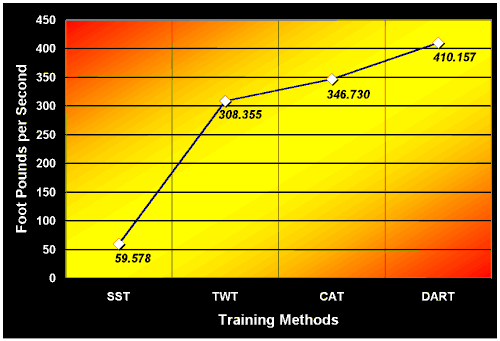
Power: .2333 x 255.372 = 59.578 foot-pounds per second (80.79 Watts)
SCENARIO TWO: Traditional Weight Training (TWT)
Tempo: 201*
Contraction Time: 1 second
Velocity: 1.1667 feet per second
Bar Weight: 75% of 1-RM = 255 pounds
Acceleration: 1.1667 feet per second
Force: 9.297 pounds to accelerate the 255 pounds
Total Force (255 + 9.297 = 264.297)
Power: 1.1667 x 264.297 = 308.355 foot-pounds per second (418.13 Watts)
SCENARIO THREE: Compensatory Acceleration Training (CAT)
Tempo: 20X*
Contraction Time: .900 seconds**
Velocity: 1.2963 feet per second
Bar Weight: 75% of 1-RM = 255 pounds
Acceleration: 1.4403 feet per second
Force: 11.477 pounds to accelerate the 255 pounds
Total Force (255 + 11.477 = 267.477)
Power: 1.2963 x 267.477 = 346.730 foot-pounds per second (470.17 Watts)
SCENARIO FOUR: Dynamic Accentuated Resistance Training (DART)
Tempo: 20X*
Contraction Time: .766 seconds**
Velocity: 1.5231 feet per second
Bar Weight (adjusted***): 75% of 1-RM = 230 pounds
Force: 14.289 pounds to accelerate the 230 pounds
Elastic Force (average): 25 pounds average stretch-resistance
Acceleration: 1.9883 feet per second
Total Force (230 + 14.289 + 25 = 269.289)
Power: 1.5231 x 269.289 = 410.157 foot-pounds per second (556.17 Watts)
*Note: Tempo: the first number is the time taken in seconds to lower the weight. The second number is the time in seconds at the bottom of the lift. The third number is the time in seconds taken to lift the weight. The digit 0 is used to represent a "no pause" or "touch and go" condition. The letter X means as fast as possible.
**Note: The contraction time was determined via video tape analysis.
***Note: The bar weight is reduced by one half of the additional 50 pounds of elastic resistance that has been added so that the average total resistance overcome through the ROM is 255 pounds (230 at the bottom, 255 mid-point, 280 at the top).
|
Power Output Graph Summary |
|
|
|
Click to enlarge. |
|
THE EFFECTS OF DYNAMIC ACCENTUATED RESISTANCE TRAINING AND COMPENSATORY ACCELERATION TRAINING ON LOWER-BODY AND UPPER-BODY STRENGTH AND POWER IN FIRE CADETS SUBSEQUENT TO TRADITIONAL TRAINING
Mike Berry, Tom Matic and Scott Lassa Milwaukee Safety Academy Milwaukee, WI 53209
ABSTRACT The purpose of this study was to compare the effects of dynamic accentuated resistance training using free weights combined with elastic rubber cords (DART) and free weight compensatory acceleration training (CAT) on the strength and power of Fire Cadets following traditional training methods. After twelve workouts using machines and traditional training the subjects were divided into two groups of equal strength abilities based on their pre-test 1-RM squat and 1-RM bench press total (n = 10). One subject was subsequently dropped from the study after suffering an illness and a non-training related injury. Groups were randomly designated either as Group 1 or Group 2. There were no significant group differences on any tests or measures. Lower-body strength and power were tested three times (pre, mid, post) with a 1 repetition maximum (1-RM) (n = 9) and with a counter-movement vertical jump (n = 9). Upper-body strength and power were tested with a (1-RM) (n = 9) and a seated medicine ball throw (n = 9). All subjects were on an identical weight training program. Group 1 trained for twelve workouts using DART followed by twelve workouts using CAT. Group 2 trained for twelve workouts using CAT followed by twelve workouts using DART. Group 1 (n = 4) (DART/CAT) and Group 2 (n = 5) (CAT/DART) performed the concentric phase of each repetition of the squat and bench press as rapidly as possible. With one exception, both groups strength and power measures increased over the 24 workouts. Significant training effects for squat strength were found for Group 1 (p < .05) and Group 2 (p < .01). Group 1 increased their squat 55 lbs. (+26%) and Group 2 by 84 lbs. (+41%). Group 1 (non-sig.) increased their vertical jump by 1.5 inches and lower-body mechanical power output by 45.1 watts (+15%) and Group 2 (non-sig.) increased their vertical jump by 1.1 inches and lower-body mechanical power output by 58.9 watts (+19%). Group 1 (non-sig.) increased their bench press 10 lbs. (+7%) and Group 2 (p < .148) by 28 lbs. (+17%). Group 1 increased their upper-body power on the medicine ball throw by 8 inches after DART training, but lost 10 inches after CAT training, for a net loss of 2 inches. Group 2 (p < .05) had significant training effects in upper-body power on the medicine ball throw with a total increase of 17.4 inches (+11%), 15.4 inches of that coming after DART training (p < .05). The results of this study suggest a hierarchical order of more effective training methods, beginning with traditional training, followed by compensatory acceleration training and ending with dynamic accentuated resistance training. |
|||||||||||||||||||||
|
|||||||||||||||||||||
Use the menu below to navigate through our informational articles. As you can see we cover all areas of strength training, including: training, supplements, dieting, etc. New articles and tips will be added regularly, so please bookmark our site, and visit often.
If you have written any strength training articles, or would like to write an article to add to our site, please email us. You will be given full credit for the article, and will help the site grow. The articles can be on training, supplementation, nutrition, or anything which is fitness related. If you own a fitness related website, please exchange links with us.
Strength Training Information
Strength Training Supplements
Strength Training Software
Strength Training Programs
Strength Training Workouts
Strength Training Exercises
Strength Training Diet
Strength Training For Women
Strength Training Blog
Strength Training Website Links
Contact Us
Disclaimer: All information contained at strengthcats.com is for informational purposes only. Consult a physician before taking and supplements or starting any diet or training program. We do not assume liability for the practice of the data included in this site. The information given if only for those 18 years old, and older. By reading the site, you release the owners of the site and authors of articles from any liability that may occur.